What Changed After the July Reform Review
The July record narrowed CMMC 20X: preserve the baseline, separate evidence from verification, name legal instruments, and test assistance before reliance.
Change record current through August 13, 2026. It describes revisions to the CMMC 20X proposal and does not predict the Reform Task Force outcome.
CMMC 20X began with a durable thesis: security work should produce current evidence that another person can trace and test. The July 13 suspension and the subsequent reform record did not replace that thesis. They forced it to become more precise.
Deep Fathom reviewed the suspension memoranda, current regulations and clauses, implementation mechanisms, cost evidence, ecosystem data, and the strongest arguments for and against rapid reform. Four changes followed.
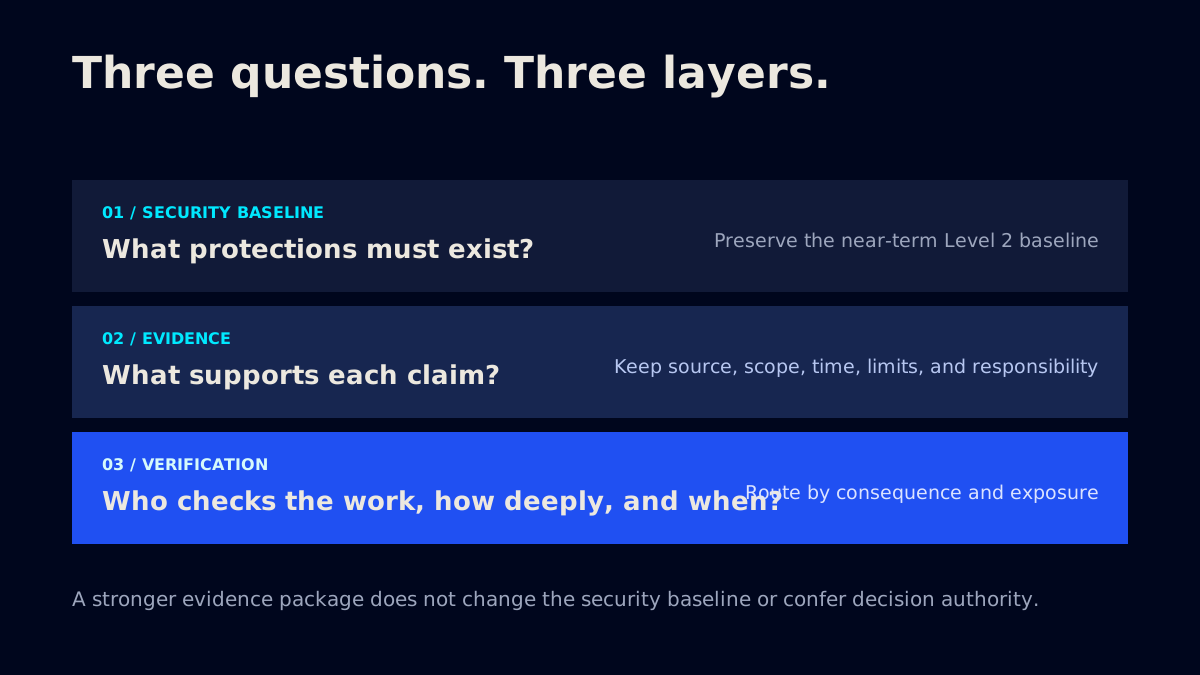
The revised proposal treats the baseline, its supporting evidence, and the method of verification as separate policy choices.
1. We stopped treating evidence modernization as a complete reform
Better evidence can reduce repeated collection, mapping, reconciliation, and package construction. It cannot implement safeguards, resolve every readiness gap, create qualified review capacity, or decide mission consequence.
The revised Blueprint therefore separates three layers:
| Layer | Governing question | CMMC 20X position |
|---|---|---|
| Security baseline | What protections must exist? | Preserve all 110 Revision 2 requirements in the near term |
| Evidence method | How is implementation made traceable and current? | Open a common, source-linked evidence profile |
| Verification | Who checks which work, how deeply, and when? | Graduate review by consequence and exposure under public criteria |
This separation prevents an evidence format from becoming an implied reduction in security. It also prevents a stronger package from being mistaken for a finding.
2. We narrowed the automation claim
Earlier reform language can easily slide from “software helps review” to “software decides compliance.” The record supports no such leap.
CMMC 20X now states the authority boundary wherever the mechanism appears: rules and AI may collect, map, compare, flag, draft, and prioritize. Qualified reviewers determine whether evidence supports a claim. Authorized people and organizations retain assessment, certification, affirmation, contracting, acceptance, and enforcement decisions.
The proposed Government pilot is consequently a no-reliance evaluation. It should compare methods on frozen cases before any output receives legal or program effect. Dangerous errors, subgroup results, corrections, and disagreements belong in the published result.
3. We made graduated verification depend on consequence
Evidence quality and mission risk answer different questions. Incomplete evidence means a claim needs correction, sampling, or escalation. It does not reveal how consequential the supplier or system is.
The revised proposal bases review depth primarily on data sensitivity, mission consequence, threat exposure, supplier criticality, and material change. Within the applicable route, evidence quality can direct attention and escalation.
This matters for small suppliers. A company’s size does not determine the sensitivity of its information or the consequence of compromise. Accessibility must come from reducing avoidable proof burden and providing workable routes across heterogeneous environments, rather than assuming that every small business presents low risk.
4. We distinguished a proposal from an implementation instrument
The July record makes the authority chain unavoidable. A Department announcement, task-force recommendation, memorandum, class deviation, regulation, solicitation amendment, and contract modification have different effects.
CMMC 20X is an independent Deep Fathom proposal. Its evidence profile is not a Government standard. Its model is a conditional systems analysis. Its pilot charter grants no program authority. Even a favorable Task Force recommendation would require the appropriate acquisition, regulatory, contractual, and governance instruments before duties changed.
This changed how the site describes action. Recommendations now name the actor and the required next record: publish criteria, open a standards process, clarify scope and inheritance, charter an evaluation, issue an authorized instrument, measure the result.
What stayed fixed
Several positions survived the review:
- CMMC should improve the security and resilience of the Defense Industrial Base.
- Documentation and evidence support that mission; neither is the mission outcome.
- The near-term Level 2 security baseline should remain intact while verification methods are tested.
- Evidence should retain source, time, scope, coverage, responsibility, limitations, integrity, conflicts, and human disposition.
- Material change should reopen affected claims.
- Providers, contractors, advisors, assessors, primes, and Government retain distinct responsibilities.
- Claims about reduced burden or improved review require measurement.
The publication changed too
The site now separates enduring architecture from the current intervention. The Blueprint states the proposal. The RFI response applies it to the Department’s present questions. The CMMC Reform Analysis tests seven policy options under declared assumptions. The evidence example exposes one synthetic record. The evaluation design states how the assistance claim could be challenged.
This Research library carries the design papers, experiments, model findings, objections, and change records behind that proposal. The result is a record readers can judge by whether its mechanisms survive inspection, whether its claims remain attached to evidence, and whether new findings change the design.
Read the underlying Phase 2 policy record, then compare the current Blueprint with the Government pilot design.
Sources and revision history.
Primary and governing sources
- 01Forging the Arsenal of Freedom: Department Suspends CMMC Phase II RequirementsU.S. Department of War
- 02Implementing Suspension of CMMC Phase IIDepartment of War Chief Information Officer
- 03Cybersecurity Maturity Model Certification Program, 32 CFR part 170Electronic Code of Federal Regulations
- 04DFARS 252.204-7012Acquisition.gov
Corrections and material revisions
No material corrections recorded.
See an error or a source we missed? Send a correction. Material changes are recorded here rather than silently overwritten.
Place this moment in the larger argument.
Current policy can change quickly. The Blueprint states the enduring CMMC 20X position; the RFI shows how Deep Fathom applies it to the Department’s current decisions.