How a Provider Claim Should Travel
A proposed exchange record for carrying provider evidence into a contractor's CMMC claim without erasing scope, customer duties, or reviewer judgment.
Current CMMC 20X evidence-exchange proposal as of August 13, 2026. The proposed fields and tests are a discussion design; they are not a Government standard, authorization, assessment method, or legal interpretation.
What must survive when provider evidence crosses a company line?
A defense contractor may rely on a cloud platform, managed service provider, security operations provider, data center, identity service, or other external service provider. The provider may operate controls, supply technical evidence, and change the service. The contractor still has to understand its own scope, configuration, use, and responsibilities.
The hard problem is the handoff. A provider statement often arrives as a report, portal screenshot, certification, questionnaire, or sales assurance. The contractor copies a fragment into its system security plan. An advisor rearranges it. An assessor later has to determine which service, tenant, time period, customer population, and security function the fragment actually covers.
CMMC 20X proposes that a provider claim travel as an exchangeable record with its limits attached. The record should help a contractor assemble its claim and help a reviewer examine it. It should never imply that provider evidence alone settles the contractor’s implementation or assessment result.
The claim is a junction
Take a managed identity service. The provider operates the platform and may configure conditional-access policies. The contractor approves users, assigns roles, manages emergency access, and decides which systems use the identity service. A cloud platform supplies native capabilities. A prime may add mission or data-handling context. Several parties contribute facts to one security claim.
That claim should link the contributions while preserving their origins. Merging everything into a narrative makes responsibility hard to test. Keeping every artifact isolated makes the combined implementation hard to see.
| Record section | Provider supplies | Contractor adds | Reviewer tests |
|---|---|---|---|
| Service identity | Service, version, hosting, tenant or customer reference | In-scope use and connected systems | Whether the named service matches actual use |
| Security function | Function performed and relevant configuration | Customer settings, procedures, and local dependencies | Whether the combined implementation addresses the objective |
| Evidence | Source, collection method, time, coverage, integrity | Local exports, tickets, observations, and interviews | Sufficiency, consistency, freshness, and population |
| Responsibility | Provider tasks and prerequisites | Customer tasks and accepted duties | Gaps, overlaps, and unsupported inheritance |
| Limits | Exclusions, blind spots, known exceptions | Local exceptions and compensating conditions | Consequence of every uncovered condition |
| Change | Version, architecture, subprocessor, or control changes | Impact on scope and implementation | Which claims and findings require renewed review |
Minimum fields for a traveling claim
The exchange record should identify the producer and the party authorized to receive it. It should name the service, customer context, security function, applicable requirement or objective, and the exact assertion being made.
It should also carry:
- Source and method: the system, document, interview, observation, test, or export behind the assertion and the method used to collect it.
- Scope and coverage: environments, tenants, accounts, assets, data paths, regions, subprocessors, and time period included.
- Responsibility split: provider work, customer work, shared work, prerequisites, and unassigned work.
- Freshness: collection time, effective period, scheduled refresh, and events that invalidate the record.
- Limits and conflicts: inaccessible sources, exclusions, contradictory evidence, known exceptions, and questions awaiting disposition.
- Integrity and lineage: identifiers, hashes where suitable, version, supersession, transformations, and prior review history.
- Review state: provider assertion, deterministic check, software analysis, human finding, or authorized decision.
These fields make the claim inspectable. They do not guarantee truth. A false provider assertion can be perfectly formatted. Conformance testing therefore has to examine both structural validity and substantive failure cases.
A proposed travel path
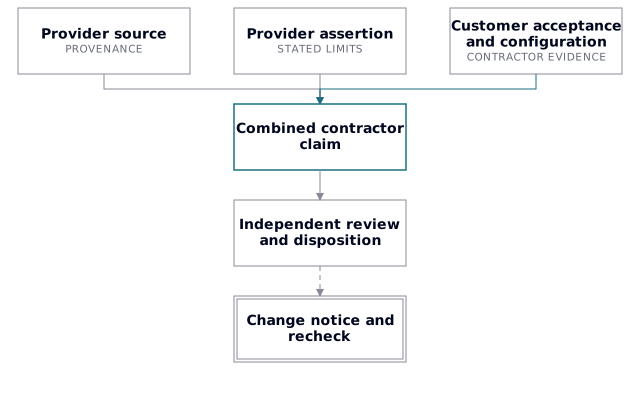
At the provider boundary, the producer signs or otherwise authenticates the record and states its permitted audience. The contractor maps the provider function to actual use, adds customer-side evidence, and records any mismatch. An advisor may help prepare the package while keeping advice separate from a finding. An assessor examines the sources and combined implementation. A later provider or contractor change reopens the affected claim.
No arrow transfers accountability wholesale. The provider owns the accuracy of its service description and evidence. The contractor owns its use, local work, scope, and affirmation. The assessor owns the finding. Government defines how such records may be used within the program.
Reuse needs constraints
Provider evidence is attractive because one service can support many customers. Reuse can also spread a mistake widely. The record needs rules for customer specificity, confidentiality, and change.
A reusable control description may explain a platform function. Customer-level proof still has to establish that the function applies to the customer’s tenant, configuration, population, and period. A provider-wide penetration test may support part of a risk picture. It may reveal little about a customer’s role assignments or local emergency access.
Some evidence cannot travel in raw form because it contains sensitive security or customer information. The exchange design should support tiered disclosure: metadata and assertion, controlled reviewer access, redacted derivative, and a way to verify integrity without exposing unnecessary content. A withheld source should remain visible as a limitation. “Available under controlled review” is a meaningful state; silent absence is not.
Failure cases for the exchange design
Feature substitution. The provider proves that a feature exists. The contractor assumes it is enabled and correctly configured. The conformance case should require customer-side configuration evidence.
Population mismatch. The export covers cloud accounts while a local emergency account remains outside the source. The record should preserve both the observed population and the expected population.
Stale inheritance. The provider changes architecture or a subprocessor after the contractor’s review. The change notice should identify affected claims and trigger re-examination.
Ambiguous responsibility. Both parties assume the other reviews privileged access. The responsibility section should reject missing ownership or mark it as an unresolved gap.
Certification overreach. A provider authorization or assessment is treated as proof of the contractor’s complete CMMC implementation. The record should state the precise use and limits of every external status.
Opaque aggregation. A provider score summarizes many controls without sources or exceptions. The record should prevent a summary from replacing the underlying claim-level lineage.
Vendor lock-in. A contractor can view the record only inside one portal. The test should require export, independent validation, and round-trip preservation across competing tools.
A public interoperability test
Government could sponsor a no-reliance test using synthetic provider and contractor cases. Publish a minimum field profile, JSON Schema, example records, and expected validation results. Invite providers, assessment organizations, contractors, and tool vendors to implement the exchange independently.
Each implementation should complete four exercises:
- Export the same provider claim with source, coverage, responsibilities, limits, and change triggers intact.
- Import another implementation’s record and render a reviewer-readable view without losing identifiers or distinctions among assertions and findings.
- Combine the provider record with customer evidence and expose a planted responsibility conflict.
- Process a provider change notice and identify every dependent contractor claim requiring review.
The test should score semantic preservation, invalid-record rejection, conflict detection, source traceability, change propagation, correction behavior, and human comprehension. Passing JSON validation alone is insufficient.
The cases should include adversarial inputs: a validly signed record with false coverage, a duplicated identifier, an expired source, a customer prerequisite hidden in prose, and a provider summary that conflicts with a raw export. Publish failures and profile revisions. Keep the test separate from contractor status until Government has evidence for acceptable uses.
OSCAL is a foundation
OSCAL demonstrates that control and assessment information can be represented in machine-readable form. It offers useful concepts for catalogs, system security plans, assessment plans, results, and plans of action. CMMC-specific provider exchange still needs defined semantics for customer responsibility, service evidence, coverage, inheritance, freshness, and review authority.
CMMC 20X’s evidence profile is a discussion implementation of those ideas. It does not claim Government endorsement. An open process should determine the minimum fields and conformance cases, with multiple vendors proving they can exchange the result.
What a successful handoff looks like
A reviewer should be able to answer five questions without reconstructing the provider relationship from email:
- What security function did the provider claim to perform?
- Which service, customer context, population, and period did the evidence cover?
- What configuration and operating work remained with the contractor?
- Which conflicts, exclusions, and changes affect the combined claim?
- Who reached each conclusion, under what method and authority?
If the record answers those questions and another tool preserves the answers, the provider claim can travel. If it arrives as a logo, score, or detached PDF fragment, the receiving party still has reconstruction work to do.
Inspect the proposed evidence profile and follow the ecosystem handoffs.
Sources and revision history.
Primary and governing sources
- 01Cybersecurity Maturity Model Certification Program, 32 CFR part 170Electronic Code of Federal Regulations
- 02CMMC Assessment Guide — Level 2, Version 2.13Department of War Chief Information Officer
- 03Protecting Controlled Unclassified Information in Nonfederal Systems and Organizations, NIST SP 800-171 Revision 3National Institute of Standards and Technology
- 04Open Security Controls Assessment LanguageNational Institute of Standards and Technology
- 05FedRAMP Security PackageFederal Risk and Authorization Management Program
Corrections and material revisions
No material corrections recorded.
See an error or a source we missed? Send a correction. Material changes are recorded here rather than silently overwritten.
Follow the claim into the working example.
Inspect the synthetic record, see how the implementation separates software output from human findings, and help vet the pilot against independent reference findings.