How a Correction Should Move Through the Record
A corrected source should reopen every dependent claim, finding, package, and authorized use without erasing the earlier decision trail.
Design paper for evidence-profile version 0.1. The propagation behavior is proposed and illustrated with synthetic records; it is not a Government requirement.
Suppose an identity export says 24 accounts use multifactor authentication. A reviewer accepts the claim. Two days later, the system owner discovers a local emergency account outside the export.
Editing “24 of 24” to “24 of 25” is necessary and insufficient. The correction changes the coverage of the source, the support for the claim, the reviewer’s finding, and every package or decision that relied on that finding.
A useful assurance record must answer two questions at once:
- What is the best current understanding?
- What did each person know when an earlier decision was made?
Overwriting history answers the first and destroys the second. Freezing every artifact preserves history and allows incorrect conclusions to keep circulating.
Corrections are dependency events
The evidence record should treat a correction as a new event attached to an earlier object. The event identifies who made it, when, why, which source changed, and which dependent records may no longer hold.
The propagation path is:
source correction → coverage change → claim reopened → finding reconsidered → package superseded → authorized user notified
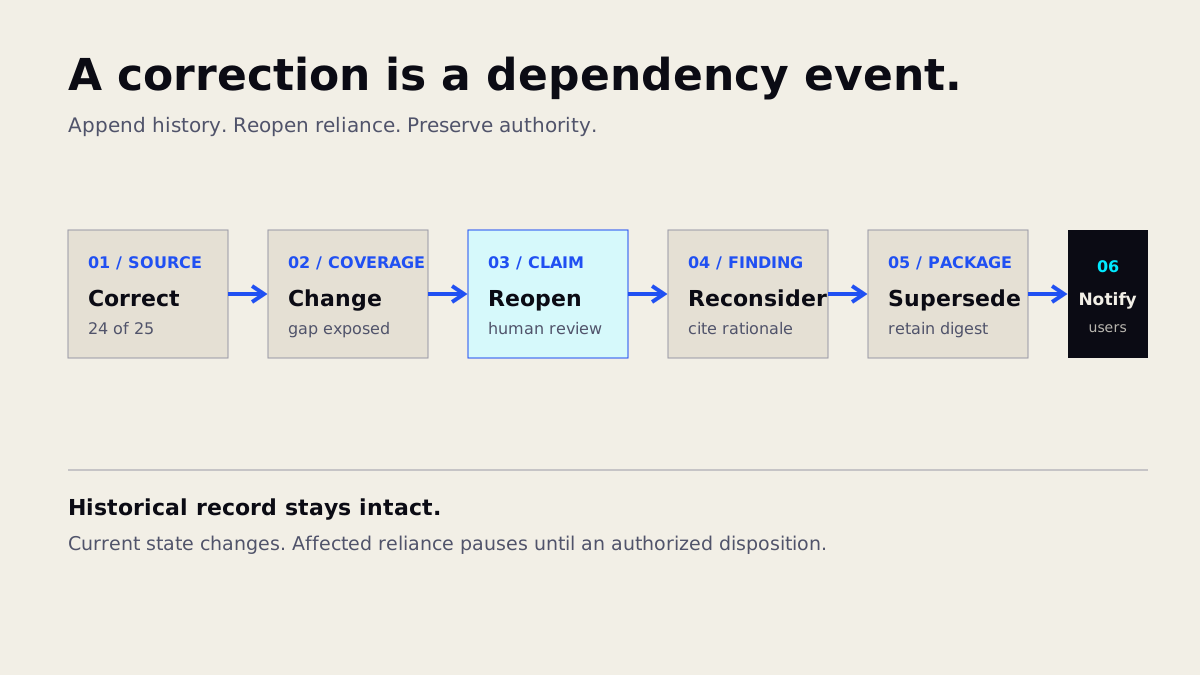
Historical facts remain intact while the current state and permitted reliance change.
Each arrow represents a recorded dependency. Software can traverse those dependencies and change workflow state. It cannot decide the substantive result.
For the MFA example, a validator can determine that the corrected expected population differs from the earlier coverage field. A rule can mark the claim for review. A qualified person must determine whether the new account lacks MFA, whether another source covers it, and whether the security requirement remains satisfied.
Preserve three layers
| Layer | Preserve | Change after correction |
|---|---|---|
| Historical | Original source, digest, finding, reviewer, and decision time | Nothing; append the correction event |
| Current | Latest source, coverage, conflicts, support state, and review state | Recompute state and reopen dependencies |
| Reliance | Packages, recipients, permitted use, expiration, and authority | Suspend or qualify affected use until disposition |
This prevents a subtle failure: correcting the central database while an exported PDF, prime portal, assessor workspace, or Government record continues to present the superseded claim as current.
Reopen the smallest defensible set
Every correction should not restart a complete assessment. The record needs enough structure to identify affected claims and downstream uses.
A corrected identity export may reopen access-control objectives supported by that export. It should not automatically reopen a physical-protection finding with independent sources. Shared dependencies still matter: if the identity source also supports privileged access, account management, and remote access claims, all of those claims may require review.
The propagation rule should be conservative when dependencies are unclear. “No known dependency” is different from “independent.” Unmapped evidence should expire or route to a person instead of silently remaining current.
Separate correction from adjudication
People sometimes resist corrections because they appear to reverse a colleague’s judgment. The system should make the stages explicit:
- Correction accepted: the source record or its metadata was wrong.
- Impact identified: dependent claims and packages were found.
- Finding reconsidered: a qualified reviewer evaluated the corrected record.
- Decision updated: an authorized person changed, retained, or limited the applicable decision.
A source correction does not automatically prove a control failure. The emergency account might enforce MFA through another mechanism. It does establish that the earlier evidence was incomplete, which is enough to reopen the claim.
Notify according to reliance
Notification should follow actual use. A draft package no one received needs a local workflow update. A record used for an affirmation, assessment, subcontract decision, or Government action requires a more consequential response.
The evidence profile should retain:
- the recipient or relying system;
- the version and digest received;
- the permitted purpose and time window;
- the authority associated with the use;
- acknowledgment and disposition of the correction.
These fields do not assign legal effect. They let authorized parties determine the correct response with an accurate trail.
The correction test
A pilot should deliberately inject corrections after review. At minimum, test:
- a changed source value;
- a source attached to the wrong system boundary;
- an expired provider responsibility statement;
- a duplicate record with conflicting dates;
- a reviewer disposition based on an omitted limitation;
- an exported package already delivered to another party.
Measure whether the system finds all dependent records, how long qualified people take to resolve them, whether recipients receive the correct update, and whether any superseded package continues to appear current.
The dangerous outcome is a clean correction log beside an unchanged reliance state. The purpose is to prevent an old claim from surviving after its basis changed.
Apply the same rule to CMMC 20X
This publication should follow the mechanism it proposes. Every research paper carries a review date, status, source list, and visible material corrections. When a source or evaluation changes a proposal, the affected paper should be revised and the prior reasoning retained in its record.
Maintained assurance is meaningful only when change reaches the places that depended on the old state. That applies to an MFA claim, an assessment package, and the reform thesis itself.
Follow the worked MFA record, inspect the evidence paper, or read the continuous assurance principle.
Sources and revision history.
Primary and governing sources
Corrections and material revisions
No material corrections recorded.
See an error or a source we missed? Send a correction. Material changes are recorded here rather than silently overwritten.
Follow the claim into the working example.
Inspect the synthetic record, see how the implementation separates software output from human findings, and help vet the pilot against independent reference findings.